


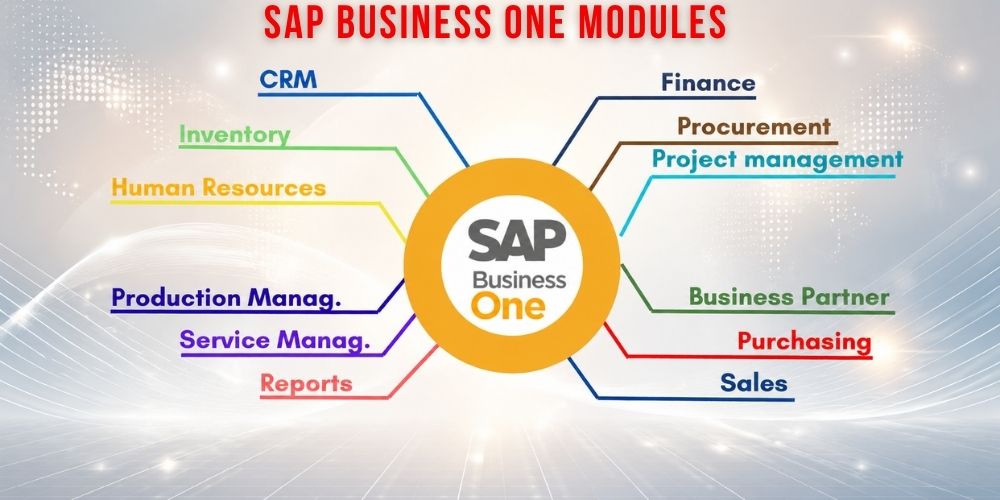
Running a small business can be overwhelming. With so many company operations, such as finances, inventory, sales, and customer relationships, it’s easy for things to slip through the cracks. That’s where SAP Business One comes in. It’s a complete ERP solution that integrates every aspect of your business into one platform, so you can stop juggling different systems and focus on what really matters: growing your business. Let’s dive into the modules that make SAP Business One a game-changer for SMBs.
Financial Management
Strong financial control is essential for sustainable business growth. SAP Business One provides an integrated financial management system that combines accounting, banking, budgeting, and reporting into a single platform. By replacing disconnected spreadsheets and manual processes, it improves data accuracy and gives finance teams a clear view of business performance.
The solution records financial transactions automatically, helping businesses maintain accurate general ledger entries while reducing administrative effort. It also supports multiple currencies and tax regulations, making it suitable for organizations operating across different markets. With built-in budgeting tools, businesses can compare actual performance against planned budgets and identify variances quickly.
Key Features
- Centralized accounting and financial management
- Automated accounts payable and receivable processing
- Multi-currency transaction support
- Built-in tax management and compliance
- Budget planning with variance analysis
- Real-time financial reporting and analytics
- Cash flow forecasting and profitability monitoring
Sales and CRM
Building strong customer relationships is just as important as closing new sales. SAP Business One combines sales management and customer relationship management in one integrated solution, enabling businesses to manage every stage of the customer journey from the initial inquiry to after-sales support.
Sales representatives can generate quotations, convert them into sales orders, and create invoices without repeatedly entering the same information. Customer records are stored in a centralized database, allowing teams to access communication history, purchasing behavior, and business preferences whenever needed.
Key Features
- Centralized customer database
- Quote-to-order sales process
- Automated invoicing and receivable tracking
- Customer interaction history
- Sales performance and buying trend analysis
- Personalized customer engagement
- Enhanced customer service and relationship management
Purchasing and Procurement
An efficient purchasing process helps businesses control costs while ensuring materials are available when needed. SAP Business One simplifies procurement by managing every purchasing activity through a connected workflow.
Purchase requests can be generated manually or automatically based on inventory requirements. The system allows organizations to collect quotations from multiple suppliers, compare pricing and delivery conditions, and select the most suitable vendor. Once approved, purchase orders are created and tracked until goods are received.
Supplier invoices are matched against purchase orders and goods receipts to improve accuracy and minimize payment errors. Additional expenses such as freight, insurance, and customs charges can also be included in inventory valuation, giving businesses a more accurate understanding of product costs.
Key Features
- Digital purchase request management
- Supplier quotation comparison
- Purchase order creation and approval
- Goods receipt processing
- Landed cost calculation
- Invoice verification before payment
- Efficient supplier payment management
Business Partner Management
Maintaining organized information about customers, suppliers, and business prospects is essential for effective business operations. SAP Business One stores all business partner information within a single database, making it easy to manage commercial and financial relationships.
Each business partner record contains important information such as contact details, addresses, payment conditions, communication history, and financial transactions. Customer and supplier balances can be monitored in real time, while built-in reconciliation tools help ensure accounting accuracy.
The integration between business partner records and financial accounts eliminates duplicate data entry and improves consistency across purchasing, sales, and accounting processes. This centralized approach provides better visibility into every business relationship while supporting faster decision-making.
Key Features
- Centralized customer, supplier, and lead records
- Contact and address management
- Flexible payment terms configuration
- Integration with financial accounts
- Customer and vendor balance monitoring
- Internal reconciliation support
- Complete visibility of business relationships
Inventory
Effective inventory management is the foundation of smooth business operations. SAP Business One enables organizations to monitor inventory in real time while seamlessly connecting purchasing, sales, finance, and warehouse activities. Every product is maintained through centralized item master records, ensuring accurate information across the organization.
The system provides complete visibility into inventory stored across multiple warehouse locations, making it easier to monitor stock availability and movement. Batch and serial number tracking improve traceability, which is especially valuable for businesses dealing with regulated or high-value products.
SAP Business One also supports different inventory valuation methods, including FIFO and Moving Average, allowing businesses to choose the approach that best matches their accounting requirements.
With powerful reports and real-time dashboards, businesses gain valuable insights into inventory turnover, stock value, and product availability, helping managers make informed decisions quickly.
Key Features
- Centralized item master management
- Batch and serial number traceability
- Real-time inventory visibility across warehouses
- Multiple inventory valuation methods
- Automated reorder and safety stock management
- Barcode-enabled inventory transactions
- Interactive inventory reports and analytics
Warehouse Management
A well-organized warehouse is essential for efficient logistics and timely order fulfillment. SAP Business One provides comprehensive warehouse management capabilities that help businesses maintain accurate inventory movement and optimize storage utilization.
The solution supports multiple warehouses, allowing organizations to manage inventory across different branches or storage facilities. Advanced bin location management enables stock to be organized by warehouse, aisle, rack, shelf, and bin, making products easier to locate and reducing picking time.
Stock transfers between warehouses are tracked automatically, ensuring inventory accuracy throughout the supply chain. Minimum stock alerts notify users when replenishment is required, helping maintain optimal inventory levels. The system also calculates product costs accurately across different warehouse locations.
By improving warehouse visibility and simplifying inventory movement, SAP Business One increases operational efficiency while reducing handling errors.
Key Features
- Multiple warehouse management
- Bin location organization
- Automated stock transfer tracking
- Inventory replenishment alerts
- Accurate warehouse costing
- Support for specialized storage locations
- Improved warehouse productivity
Production Management
Manufacturing businesses require complete control over production planning, material usage, and resource allocation. SAP Business One offers integrated production management tools that simplify manufacturing operations from planning to completion.
Bills of Materials (BOMs) define every component needed to manufacture finished products, while production orders manage the complete manufacturing process. Routing information and work centers help organize production activities efficiently, ensuring resources are utilized effectively.
Material Requirements Planning (MRP) automatically calculates the materials required for production based on demand forecasts and existing inventory. Throughout production, businesses can monitor raw material consumption, labor usage, and production progress in real time.
Key Features
- Bill of Materials (BOM) management
- Production order processing
- Routing and work center planning
- Material Requirements Planning (MRP)
- Capacity planning support
- Shop floor activity monitoring
- Integrated quality management
Project Management
Managing projects successfully requires careful planning, cost control, and collaboration. SAP Business One provides a centralized platform where project information, tasks, budgets, and documentation can be managed from a single location.
Projects can be divided into multiple stages and tasks, allowing teams to monitor progress throughout the project lifecycle. Financial information, including project budgets, expenses, and profitability, is tracked continuously to help maintain financial control.
Organizations can also manage subprojects, assign resources efficiently, and store related documents within the project structure. Built-in reporting tools provide visibility into project performance, helping managers identify potential delays and take corrective actions before issues escalate.
Key Features
- Project planning and task management
- Budget and expense monitoring
- Resource allocation
- Hierarchical project structure
- Document management
- Project performance reporting
- Progress and issue tracking
Material Requirements Planning (MRP)
Efficient production depends on having the right materials available at the right time. SAP Business One’s Material Requirements Planning (MRP) functionality helps businesses forecast material demand and maintain optimal inventory levels.
The system analyzes sales forecasts, production schedules, inventory availability, and supplier lead times to generate accurate procurement recommendations. Based on this analysis, SAP Business One automatically suggests purchase orders and production orders whenever additional materials are required.
Key Features
- Material demand forecasting
- Inventory and lead time analysis
- Automatic purchase recommendations
- Production order planning
- Reduced inventory shortages
- Optimized stock levels
- Improved supply chain planning
Service Management
Providing reliable after-sales service is essential for building long-term customer relationships. SAP Business One includes a dedicated service management module that helps organizations manage warranties, service contracts, customer equipment, and support activities from one integrated platform.
Businesses can record service requests, monitor contract terms, and track warranty information throughout the customer lifecycle. Customer equipment history and maintenance records are stored centrally, enabling faster issue resolution and better service quality.
By streamlining support operations and improving response times, SAP Business One enhances customer satisfaction while strengthening long-term business relationships.
Key Features
- Service contract management
- Warranty tracking
- Customer equipment records
- Service request management
- Customizable service agreements
- Faster issue resolution
- Improved customer support
Human Resources
An organization’s workforce plays a key role in business success, and SAP Business One simplifies employee information management through its Human Resources functionality.
The system stores comprehensive employee records, including personal information, qualifications, employment history, and performance reviews. Attendance, leave records, and timesheets can be managed efficiently, supporting accurate payroll and workforce planning.
Managers can also monitor employee costs, analyze workforce performance, and generate HR reports that support better decision-making. By centralizing HR information, SAP Business One reduces administrative work while improving overall employee management.
Key Features
- Employee master record management
- Qualification and employment history tracking
- Attendance and leave management
- Timesheet management
- Employee cost analysis
- HR reporting and analytics
- Streamlined workforce administration
Benefits of SAP B1 Implementation
By automating tasks like invoicing and inventory tracking, SAP B1 frees up time for your team to focus on more important tasks.
With SAP Business One, you can make decisions faster because you’re always working with the most up-to-date data. No more waiting on reports or trying to make sense of outdated numbers.
As your business grows, SAP B1 grows with you. You can add modules or features as needed, so you’re always ready for the next step in your growth journey.