


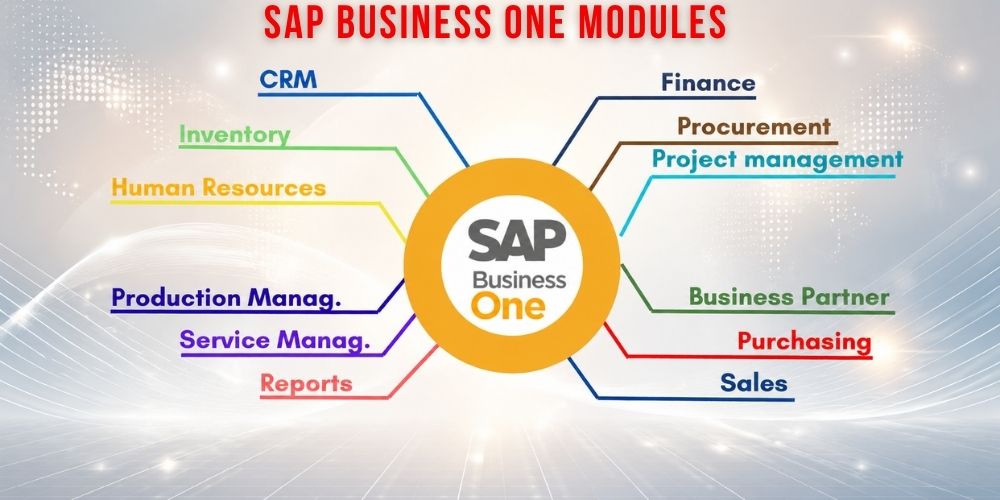
At its core, an ERP system exists to ensure every department works from the same source of information. Different teams within a company need access to the same data. Finance cannot close the books accurately if sales data is stored separately. Procurement decisions rely on production demand, while leadership teams need a complete view of the organization rather than isolated pieces of information.
What is SAP S/4HANA?
SAP S/4HANA is SAP’s next-generation ERP solution, built to help businesses operate with greater speed, intelligence, and efficiency. It is designed to replace the earlier SAP ECC environment that many organizations have relied on for years. While SAP ECC supported a wide range of business processes, its architecture was built around the database technologies available at the time it was developed.
S/4HANA Moves Away From That Older Model.
Since it is based in conjunction with its SAP HANA in-memory database, the system is able to process massive datasets directly in memory. That eliminates many of the intermediate steps older ERP systems required for reporting. Instead of moving data into separate structures just to generate reports, the system can perform calculations on the transactional data itself.
Another noticeable change appears on the user side. The platform introduces the SAP Fiori interface, which replaces many traditional SAP screens with role-based applications. Instead of having to navigate through a long list of transactions, users connect through apps that focus on their everyday tasks.
What Is SAP S/4HANA Modules in the Lines of Businesses?
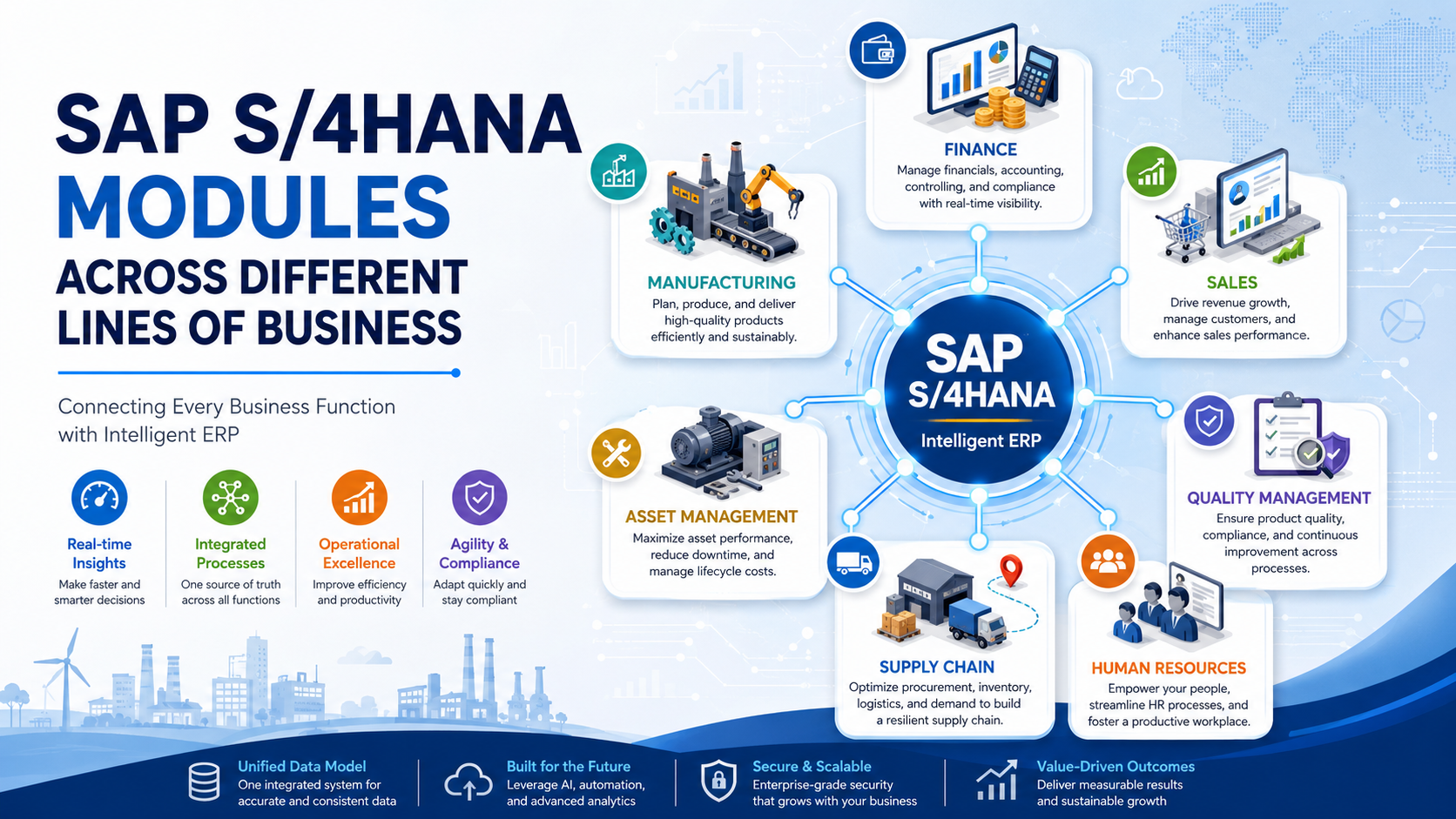
Within S/4HANA, SAP organizes functionality around what it calls lines of business. Each of these represents a major operational area inside an organization.
Finance, manufacturing, sales, supply chain, human resources, and product development are the most common examples. Inside each of these areas sit modules that handle specific business processes.
This structure is what makes the SAP S/4hana modules list flexible. An organization does not have to install every module in order to begin reaping the benefits of the system. Most organizations start with the most important areas and gradually broaden the scope after the foundation is solid.
It is important that each module works on the same data model. Even if different teams use different modules, the information they generate remains connected across the ERP environment.
The following sections look at how these modules align with different business functions.
Finance (FI)
In most ERP transformation programs, finance tends to be the first area that organizations focus on. That is partly because financial reporting affects every part of the business.
The Finance module, commonly known as FI, manages the core accounting activities within the system. This includes general ledger accounting, accounts payable, accounts receivable, and the financial closing process, which together form the foundation of financial operations in SAP S/4HANA. A more detailed explanation of how these processes work in practice can be found in this overview of financial processes in SAP S/4HANA.
One structural change introduced with S/4HANA is the Universal Journal. Instead of storing financial and controlling data across multiple tables, the system combines them into a single structure. For finance teams, this simplifies reporting quite a bit.
The Controlling module, usually referred to as CO, works alongside FI. It focuses more on internal financial analysis. Cost center accounting, profitability analysis, and internal cost tracking are handled here.
Together, these two modules form the financial backbone of the platform.
For many organizations, improvements in reporting speed and transparency make finance modernization the logical starting point for SAP ECC to S/4HANA migration initiatives.
Manufacturing
Manufacturing environments rarely run in isolation. Everything is connected. If one activity slows down—even slightly—it tends to ripple across the entire production chain. Materials arriving late affect production schedules. Production delays impact delivery commitments. Procurement then has to react, often at the last minute.
That’s where ERP coordination becomes critical, and this is exactly the type of operational alignment systems like SAP S/4HANA were designed to handle.
Within S/4HANA, Production Planning (PP) carries most of the responsibility for manufacturing planning. It covers material requirements planning, production scheduling, and the management of production orders.
In practice, this module answers the kinds of questions plant planners deal with every day.
Do we actually have enough raw material for the production run scheduled next week?
Will the machines be available when a sudden large order comes in?
And more importantly—can the plant deliver on time without creating bottlenecks further down the line?
Because PP connects directly with procurement and inventory data, planners are no longer working with fragmented information. They perceive the situation in its current form rather than as it was yesterday.
Quality Management (QM)
Quality Management is an important function in manufacturing processes. This module is focused on the planning of inspections, tracking defects and monitoring compliance across the lifecycle of production.
In industries like pharmaceuticals or manufacturing for automobiles, high-quality processes aren’t just a matter of best practice, they’re required. Audits for compliance, regulatory audits and traceability requirements require well-organized systems.
When these manufacturing-related modules are implemented properly, information begins to move naturally across departments. A confirmed sales order can trigger production planning automatically. Inventory records update as materials move through the plant floor. Finance immediately sees the cost implications.
That level of coordination is precisely what ERP systems were originally meant to deliver.
Sales
The sales function inside an ERP system has a straightforward goal: convert customer demand into revenue while keeping the rest of the business informed about what’s coming.
The module responsible for this is Sales and Distribution, commonly referred to as SD.
It manages the entire lifecycle of a customer transaction. A process that often begins with a simple product inquiry eventually moves through quotation management, order creation, delivery coordination, and billing.
What makes the architecture of SAP S/4HANA particularly useful is how quickly these events become visible across the system.
The moment a sales order is created, several other areas are affected.
Finance immediately sees projected revenue.
Inventory teams can verify product availability.
Production planners can determine whether additional manufacturing capacity will be required.
That lag disappears when the system operates on a unified dataset. Many organizations also connect the SD module with analytics tools or customer experience platforms. It also provides a better understanding into purchasing behavior and customer trends. This helps sales professionals forecast the needs of their customers and manage their pipelines more efficiently.
Supply Chain
If you’ve spent any time around ERP projects, you already know this: supply chain is where everything converges. Procurement, manufacturing, warehousing, logistics — they all meet here. When there is a problem in this field the problem is not always confined to one area. The ripple typically spreads to the finance and planning departments as well as the delivery of services to customers pretty quickly.
Inside SAP S/4HANA, Materials Management handles most of the procurement-heavy lifting. Purchase orders, records of suppliers invoices, receipts for goods, validation, everything that is part of the standard procurement cycle is here.
On paper those activities sound routine. In reality, they’re the gears that keep the entire operational engine moving.
Procurement teams, for example, don’t just “place orders.” They rely on demand signals coming from production planning and inventory levels. If the planning data is wrong, procurement decisions will be wrong too. And that’s exactly why integrated ERP matters.
When these systems are wired together properly, things start working the way they should. Inventory updates the moment goods arrive. Production planners instantly see whether materials are available. Finance receives cost postings automatically without someone manually reconciling spreadsheets at month-end.
Companies running large distribution networks often go a step further by adding tools like SAP Extended Warehouse Management (EWM) and SAP Transportation Management (TM).
Those systems coordinate warehouse activity, optimize shipping routes, and help logistics teams manage freight movements across regions. Once a company starts shipping products across multiple countries or large distribution hubs, that kind of visibility stops being a luxury – it becomes operationally necessary.
And that’s typically where these capabilities show up in most SAP S/4HANA modules implementations.
Human Resources (HR)
HR has been part of ERP systems for decades, even though it sometimes sits slightly outside the spotlight compared to finance or supply chain.
Think about it. Employee records, payroll calculations, leave tracking, workforce planning — all of that needs structured systems. Spreadsheets don’t survive long once a company reaches scale.
Older SAP environments handled this primarily through the SAP HCM module. With SAP S/4HANA, many organizations now combine ERP capabilities with Success Factors, which focuses more on the broader employee lifecycle — recruiting, learning, performance management, and employee engagement.
Even when HR tools run in the cloud, integration with the ERP core still matters.
Payroll costs need to flow into financial systems. Workforce planning affects budgeting. Project staffing affects cost allocation. Without those connections, organizations would end up maintaining parallel financial records for workforce expenses — which defeats the whole purpose of running an integrated ERP platform.
When HR data flows properly into finance and planning systems, leadership teams get something valuable: a much clearer view of workforce costs, productivity trends, and long-term hiring needs.
And that visibility is increasingly becoming part of how organizations evaluate the broader SAP s 4hana modules list when modernizing their ERP environments.
Asset Management
Some industries rely heavily on physical equipment. Manufacturing plants, utilities, and energy companies all fall into this category.
For them, asset reliability is just as important as financial performance.
Enterprise Asset Management within SAP S/4HANA helps organizations track equipment lifecycles, maintenance schedules, and service history.
This Plant Maintenance component helps with the planning of preventive maintenance. Instead of waiting around for the equipment to fail, companies can schedule maintenance programs according to the patterns of use or operating times.
This approach over time can reduce unexpected downtime and prolong the lifespan of costly assets.
Some companies also integrate the data from assets with analytics platforms to investigate possibilities for predictive maintenance. In these situations, performance data from equipment can be a sign of potential issues prior to them cause interruptions in operation.
Benefits of SAP S/4HANA Migration.
The migration to S/4HANA has many benefits beyond simply updating ERP technology.
One of the most important enhancements is the real-time analytics. Since S/4HANA handles information in the memory of the system, businesses can create reports directly based on transactional information and without having to rely on distinct data warehouses.
Another major benefit of SAP S/4HANA is simplified system architecture. Elimination of duplicate tables and aggregates lowers the complexity of the system as well as improving performance.
Efficiency in operation is a key benefit. Integrated modules enable different departments to share the same data that reduces manual reconciliation, as well as increasing collaboration.
The platform also provides an infrastructure for the development of new technologies like AI, Advanced Analytics as well as process automation. These capabilities allow organizations to modernize business processes and maintain the security and reliability that is expected of the most reliable enterprise ERP systems.